Faịlụ:On the hunt for newborn stars.tif
Gaa na nsoroụzọ
Malie na ịchọọ
Size of this preview of this TIF file: 664 × 600 piksels. Ndị ọzọ mkpebi:266 × 240 piksels | 532 × 480 piksels | 850 × 768 piksels | 1,134 × 1,024 piksels | 2,268 × 2,048 piksels | 3,425 × 3,093 piksels.


Failụ si na nke mbu (3,425 × 3,093 pixel, ívù akwukwo orunótu: 19.53 MB, MIME nke: image/tiff)
Mmẹkụwátá
| Nkówá |
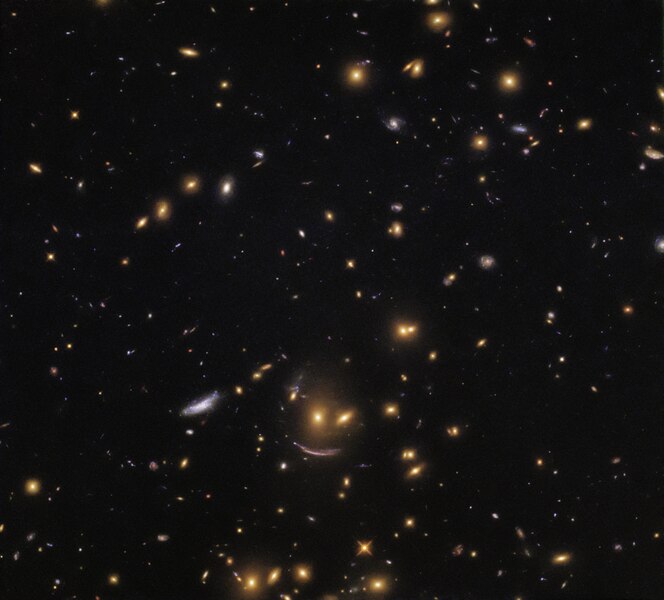
English: This image, taken with the NASA/ESA Hubble Space Telescope's Wide Field Camera 3 (WFC3), shows a patch of space filled with galaxies of all shapes, colours, and sizes. WFC3 is able to view many such galaxies at an unprecedented resolution — high enough to locate and study regions of star formation in a bid to understand how new stars spring to life throughout the cosmos.
Stars are born within giant clouds of gas. These massive clouds, or stellar nurseries, grow unstable and begin to collapse under gravity, becoming the seeds that will grow into new stars. By analysing the luminosity, size, and formation rate of different stellar nurseries, scientists hope to learn more about the processes that can lead to the formation of a newborn star. Studying nurseries within different galaxies will provide information about star formation at different points in time and space throughout the Universe. Just below centre in this image is a formation of galaxies akin to a smiling face! Two yellow-hued blobs hang atop a sweeping arc of light, forming a celestial object known as SDSSJ0952+3434. The lower, arc-shaped galaxy has the characteristic shape of a galaxy that has been gravitationally lensed — its light has passed near to a massive object en route to us, causing it to become distorted and stretched out of shape. |
| Ǹgụ́ụ̀bọ̀chị̀ | |
| Mkpọlọ́gwụ̀ | https://www.spacetelescope.org/images/potw1842a/ |
| Odé ákwụ́kwọ́ |
ESA/Hubble & NASA Acknowledgement: Judy Schmidt (geckzilla) |
Nkwényé
  |
ESA/Hubble images, videos and web texts are released by the ESA under the Creative Commons Attribution 4.0 International license and may on a non-exclusive basis be reproduced without fee provided they are clearly and visibly credited. Detailed conditions are below; see the ESA copyright statement for full information. For images created by NASA or on the hubblesite.org website, or for ESA/Hubble images on the esahubble.org site before 2009, use the {{PD-Hubble}} tag.
Conditions:
Notes:
|
.jpg) |
This file is licensed under the Creative Commons Attribution 4.0 International license.
Í-kpó-áhà:
ESA/Hubble
- I wepulara nóru:
- i nye – ikọpị,ikekasi na izịpụ ọru a
- i dowaria – igbanwee ọrụ a
- Ọ ga bụ na ọnọdụ ndi a:
- í-kpó-áhà – Ị ga-enyerịrị ugo kwesịrị ekwesị, nye njikọ na ikikere ahụ, ma gosikwa ma emere mgbanwe. Ị nwere ike ime ya n'ụzọ ezi uche ọ bụla, mana ọ bụghị n'ụzọ ọ bụla na-egosi na onye nyere ikikere kwadoro gị maọbụ ojiji gị.
Ịta nke usòrò
Bìri èhì/ogè k'ị hụ òtù ụ̀fa dị̀ m̀gbè ahụ̀.
| Èhì/Ogè | Mbọ-aka | Ógólógó na asaá | Òjìème | Nkwute | |
|---|---|---|---|---|---|
| dị ùgbu â | 15:28, 15 Ọktoba 2018 |  | 3,425 × 3,093 (19.53 MB) | wikimediacommons>Jmencisom | User created page with UploadWizard |
Ojiji faịlụ
Ihe ndị na-eso ihe eji Ihu akwụkwọ eme na faịlụ a: